

Variable frequency drives for lifts: what they do and when to replace one
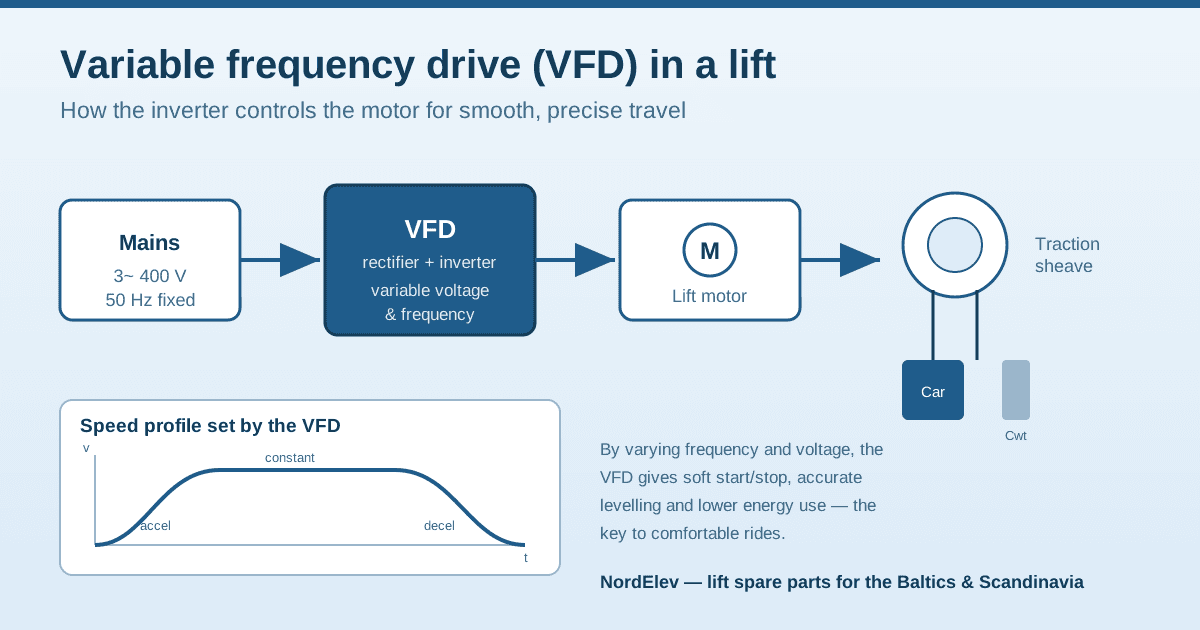
The variable frequency drive (VFD), also called a frequency converter or inverter, is the component that controls how a lift motor starts, runs and stops. Instead of feeding the motor the fixed mains frequency, the drive continuously adjusts voltage and frequency, so the car accelerates smoothly, holds a steady travel speed and levels precisely at each floor.
What the drive controls
A modern lift drive manages soft start and stop, the travel speed profile, stopping accuracy at the landing, and energy consumption. On gearless and permanent-magnet machines it also handles motor field control with encoder feedback, which is what makes the ride quiet and comfortable.
Signs the drive needs replacing
Rough or jerky acceleration, inaccurate levelling, repeated fault trips, overheating, unusual noise from the motor, or spare parts that are no longer manufactured for an older unit. When a controller is modernised from a direct, uncontrolled drive to inverter control, a matching frequency converter is part of that upgrade.
Choosing a replacement
The key parameters are motor power rating (kW) and current, input supply (single- or three-phase, voltage), motor type (geared, gearless or permanent-magnet synchronous), control mode (open- or closed-loop with encoder), and whether a braking resistor or regenerative unit is required. Matching these to the existing machine and controller is more important than the brand on the label.
How NordElev helps
We supply frequency converters and related lift spare parts and deliver them across the Baltics, Scandinavia and Finland. Send us the data from the nameplate of your motor and existing drive, and we will help you match the correct unit. Contact us for availability and a quote.